
Description
Overview
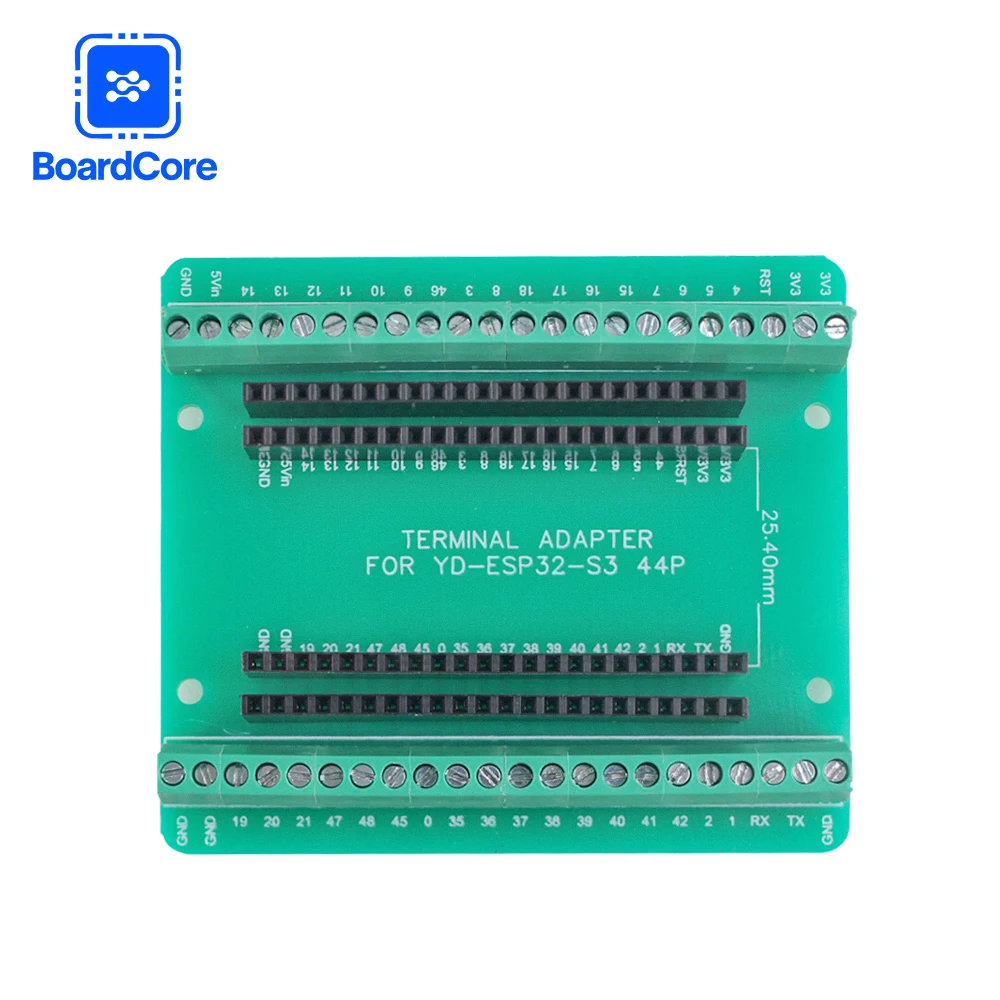
The ESP32‑S3 Development Board is a versatile 44‑pin expansion breakout designed specifically for the ESP32‑S3 module. Engineered for rapid prototyping, hobby projects, and commercial IoT solutions, this board delivers powerful dual‑core processing, Wi‑Fi 6 and Bluetooth 5.0 connectivity, all in a compact, breadboard‑friendly form factor.
Key Highlights
- 44‑pin breakout with clearly labeled pins for easy wiring and solder‑free prototyping.
- Dual‑core Xtensa® 32‑bit LX7 CPU up to 240 MHz for high‑performance applications.
- Integrated Wi‑Fi 6 (802.11 b/g/n) and Bluetooth 5.0 (LE) for reliable wireless communication.
- Built‑in USB‑C power & data interface with 5 V/3.3 V regulation.
- Supports Arduino IDE, ESP‑IDF, MicroPython, and PlatformIO for flexible development.
- Low‑power modes (ULP co‑processor) ideal for battery‑operated devices.
- On‑board RGB LED and reset/program buttons for quick debugging.
- Compact 30 mm × 45 mm layout fits standard breadboards and enclosures.
Technical Specifications
- Processor: Dual‑core Xtensa® LX7, 240 MHz
- Flash Memory: 4 MB (expandable via external SPI flash)
- RAM: 520 KB SRAM
- Wireless: Wi‑Fi 6 (802.11 b/g/n), Bluetooth 5.0 LE
- GPIO: 44 pins (including ADC, DAC, SPI, I²C, UART, PWM, Touch)
- Power Supply: USB‑C 5 V input, 3.3 V regulator, 500 mA max
- Operating Temperature: -40 °C to 85 °C
- Dimensions: 30 mm × 45 mm × 1.2 mm
Why Choose This Board?
Designed for developers who need a reliable, feature‑rich platform, the ESP32‑S3 Development Board simplifies hardware integration while delivering the processing power required for AI‑at‑the‑edge, sensor fusion, and real‑time data analytics. Its extensive pinout and comprehensive software support reduce time‑to‑market, making it perfect for both beginners and seasoned engineers.
Ideal For
- IoT devices: smart home, wearables, and remote monitoring.
- AI edge applications: voice recognition, image processing with built‑in vector extensions.
- Robotics and automation: motor control, sensor networks, and real‑time feedback.
- Educational projects: Arduino, MicroPython, and ESP‑IDF learning kits.
- Prototyping and product development: rapid PCB design and testing.


Reviews
There are no reviews yet.