
Description
Product Overview
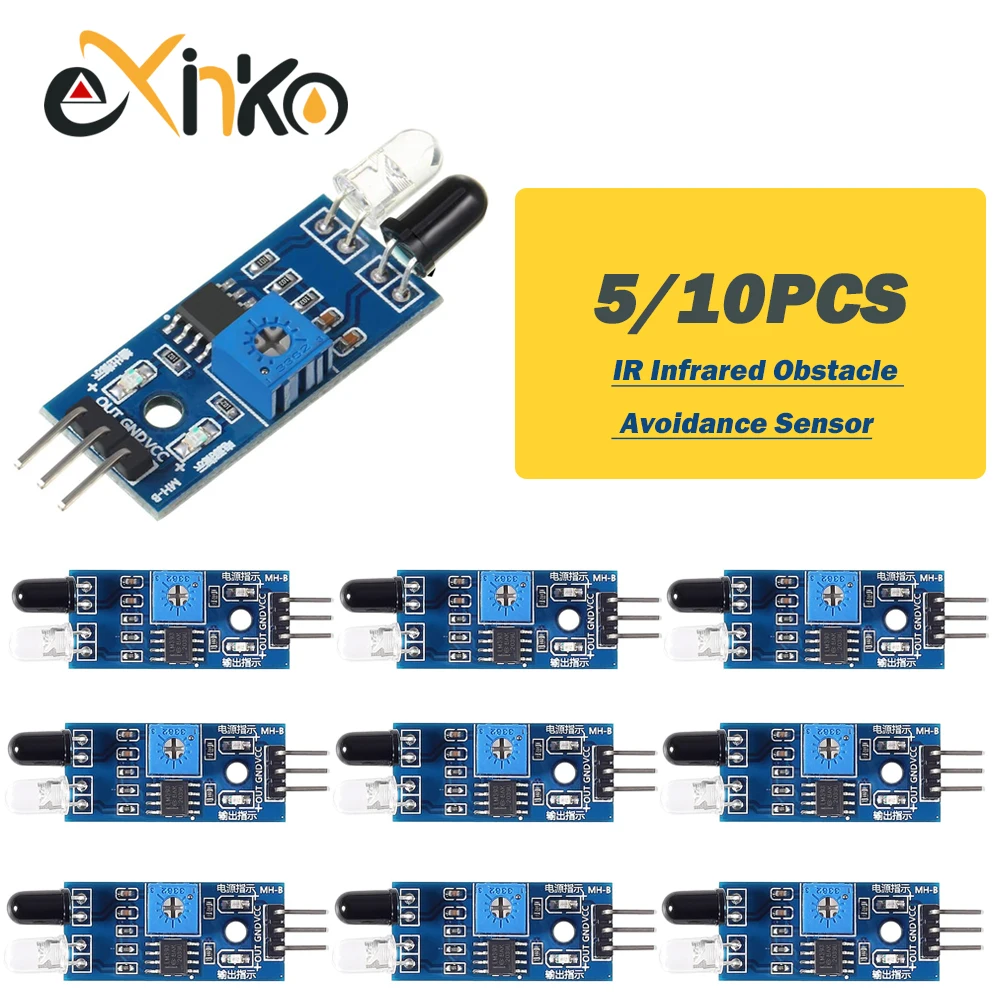
Elevate your DIY robotics and smart car projects with our 5/10pcs IR Infrared Obstacle Avoidance Sensor Module. Designed for Arduino and other microcontroller platforms, this reflective photoelectric sensor delivers reliable obstacle detection, ensuring smooth navigation and enhanced safety for your robotic creations.
Key Features
- High‑precision infrared detection with a 3‑pin interface (VCC, GND, OUT)
- Rapid response time for real‑time obstacle avoidance
- Wide detection range: 10 cm to 80 cm (adjustable with onboard potentiometer)
- Low power consumption – ideal for battery‑powered robots
- Compact, lightweight design fits easily into small chassis
- Compatible with Arduino Uno, Mega, Nano, ESP32, and more
- Ready‑to‑use out of the box – no additional components required
Applications
These IR sensors are perfect for:
- Arduino smart car robots and line‑following bots
- Obstacle‑avoiding drones and RC vehicles
- Educational STEM kits and robotics competitions
- Home automation security systems
- Industrial automation and automated guided vehicles (AGVs)
Technical Specifications
- Operating Voltage: 3.3 V – 5 V
- Output Type: Open‑collector (digital)
- Detection Distance: 10 cm – 80 cm (adjustable)
- Power Consumption: < 50 mA
- Package Size: 30 mm × 20 mm × 10 mm
- Operating Temperature: –10 °C to +70 °C
Package Includes
- 5 or 10 IR obstacle avoidance sensor modules (choose your quantity)
- 3‑pin female headers for quick wiring
- Quick‑start wiring diagram PDF
- Warranty card and support guide
Why Choose Our IR Sensor Module?
Our sensors combine affordability with uncompromised performance. Whether you’re a hobbyist building a prototype or a professional developing commercial robotics, these modules provide consistent, high‑quality detection that reduces development time and enhances reliability.
Compatibility
Plug-and-play with popular microcontrollers: Arduino Uno, Mega, Nano, ESP32, STM32, Raspberry Pi (via GPIO), and any board supporting 3‑pin digital I/O.
Installation & Setup
1. Connect VCC to 5 V (or 3.3 V) on your board.
2. Connect GND to ground.
3. Wire the OUT pin to a digital input on your microcontroller.
4. Adjust the potentiometer to set the desired detection distance.
5. Upload a simple obstacle‑avoidance sketch and start testing.
Customer Support
Our team is ready to help you with wiring diagrams, code samples, and troubleshooting. Contact us via email or our support portal for fast, reliable assistance.




Reviews
There are no reviews yet.